
Preparing for a conversation
Use a household snapshot to see the figures you need to explain to a family member or professional. Take the relevant statements too: the total cannot establish their accuracy or ownership.
Net worth is the value of what you own less what you owe. Enter your figures to see a snapshot in Australian dollars, then check the records behind the result.
Inputs stay in this browser tab and clear on reload. Download if you want to keep a copy.
User-entered estimate in AUD. No sale costs, tax, borrowing eligibility or state-specific rules are calculated. General information, not personal financial, tax or legal advice.
Follow the tool, step by step
Choose a guide below. Follow the labelled screenshot, then try it with your own information.
Step 1 of 3
Choose Household, Individual or Entity so all values use the same scope. Enter current property, superannuation, savings, investments and other asset values under What you own. For an individual view, use the amounts attributable to that person. Blank amounts count as zero.
Try this in the tool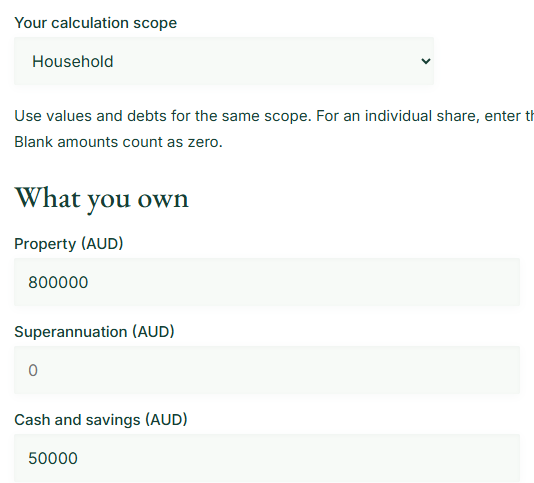
Step 2 of 3
Under What you owe, enter outstanding mortgages, investment loans, personal loans and other debts for the same scope. Count each debt once. Do not add home equity as a separate asset when the property value and mortgage are already included.
Try this in the tool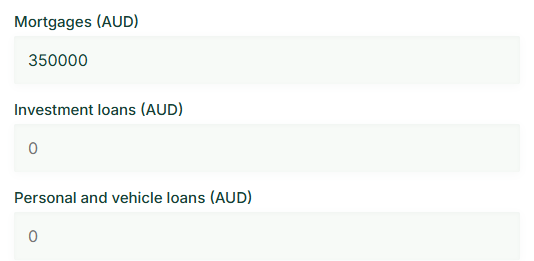
Step 3 of 3
Select Calculate net worth, check the asset and liability totals, then download your snapshot if useful. Changing an input clears the previous result so you can calculate again. Keep the source dates with your downloaded file.
Try this in the tool
Worked example
A$850,000 of assets minus A$350,000 of liabilities gives A$500,000. The property contributes its full recorded value; adding its equity again would count the same wealth twice. This example omits other holdings to make the arithmetic easy to follow.
Follow the inputs

 FINANCIAL PORTFOLIO
 Dated asset valuesOwners and source files
Take the next step with Financial Portfolio
A snapshot answers today’s question. Financial Portfolio connects the assets and liabilities behind it to their owners and supporting documents. Maintain the records yourself as new statements arrive, and review the wider picture from your dashboard.
App access is currently through the waitlist. Keep your download for reference. Tool entries are not sent to the app or imported automatically.
Choose whether this is your personal or household view. Enter current asset values for property, superannuation, cash, investments, business interests and other holdings relevant to that scope. Add outstanding mortgages, investment loans and other liabilities. Use the same valuation date where practical; include each asset and loan once. For jointly held assets, include only the share relevant to your chosen scope or use a household scope consistently. Do not add a property's equity as a second asset after entering both its full value and the mortgage.
Total assets − total liabilities = estimated net worth. A result of A$850,000 in assets less A$350,000 in debt is A$500,000. This is a user-entered estimate, not a sale price, tax calculation, forecast or advice. No state-specific tax or benefit rules are applied, so the same arithmetic covers all six states and both territories. ASIC Moneysmart uses the same assets-and-debts method.
Save your source dates outside the calculator. To maintain a connected record of the assets, loans, owners and documents behind the number, explore the net worth dashboard and asset records and liability records in Financial Portfolio.
The tool runs in this browser tab. Your inputs are not sent to Financial Portfolio, stored in a user account or passed through the signup link. A reload clears the working state. Download a CSV if you want a copy, and keep it somewhere appropriate for the information it contains.
Financial Portfolio can help you maintain related records, but this public result does not create a portfolio or verify a source document. Read the privacy policy and terms of use, or visit the Help Center for product questions.
Put the result to work
Use a household snapshot to see the figures you need to explain to a family member or professional. Take the relevant statements too: the total cannot establish their accuracy or ownership.
Repeat the calculation using the same categories and scope. Keep both downloads and their source dates. A change may reflect a repayment, a revised valuation or a missing entry; the calculator cannot identify the reason by itself.
Include the household's assets and debts once, then subtract debts from assets. Decide how you will treat jointly held or entity-owned items before entering them.
It is commonly included as an asset in a broad net worth snapshot. Use the value in a recent statement and remember that access, tax and benefits rules are separate questions. Moneysmart explains superannuation.
Look for a different valuation date, missing liabilities, duplicate entries or a different personal/household scope. The dashboard depends on the records you maintain.
From a useful start to connected records
Explore how Financial Portfolio connects the assets, debts, people and paperwork you maintain.